
LitBuy in brief: the agent, the order path and where returns fit
The basics of the agent behind these cards: who runs it, how an order moves from a link to your door, and the point in that path where the return rules apply.
LitBuy itself: the company, the warehouse, the apps
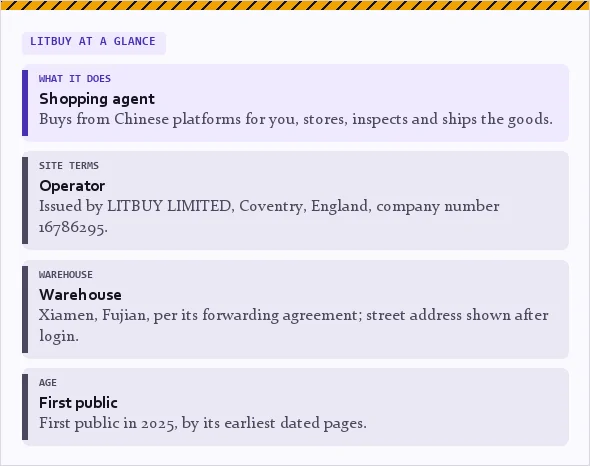
What is LitBuy? A shopping agent: you send it a product link from Taobao, 1688, Weidian or another Chinese platform, it buys the item for you, receives it at its warehouse, photographs it and ships it abroad together with your other orders.
The site terms come from LITBUY LIMITED, registered in England with an address in Coventry and company number 16786295. The warehouse is in Xiamen, Fujian, according to its parcel forwarding agreement; the street address appears only after login. Its earliest dated pages are from 2025, and it has iOS and Android apps.
LitBuy says it charges no fee for the purchasing service itself. There are separate small charges elsewhere, including the CNY 5 return fee this site keeps coming back to.
- Help 43 Service & Fees, updated 23 June 2026
How to use LitBuy and this LitBuy Spreadsheet, step by step
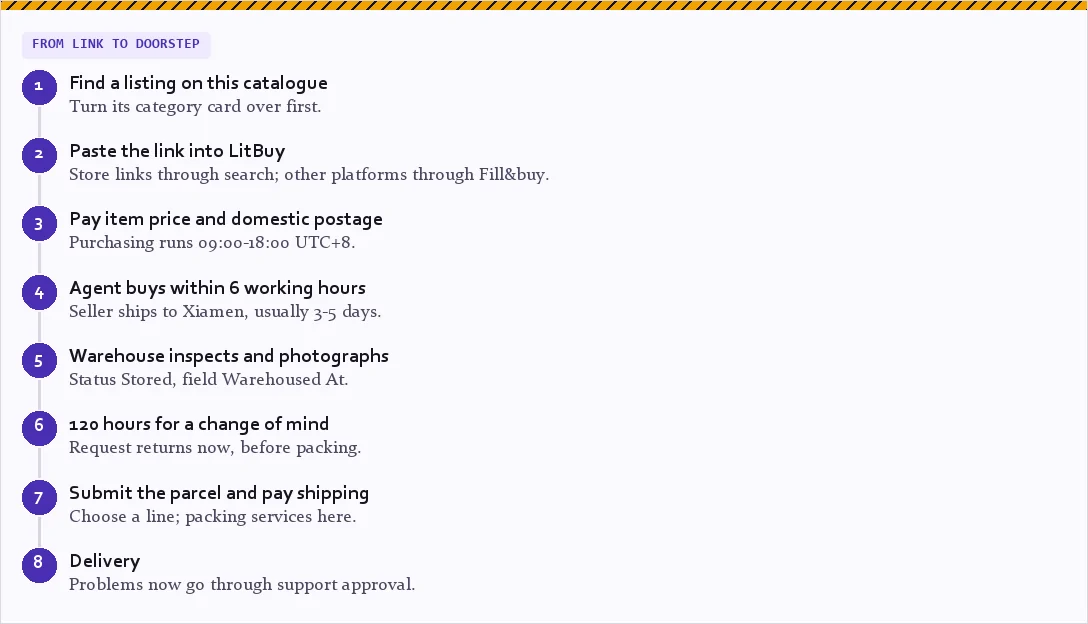
Start on this catalogue: find a listing, but turn its category card over before you copy the link. Paste store links into LitBuy's search, or use Fill&buy for platforms it cannot search. Pay the item price and the seller's domestic postage; LitBuy places orders in a daytime window that opens at 09:00 UTC+8, and the detailed how-to text mentions six working hours while its summary mentions 24 hours. Neither is a guarantee for an individual order; follow its actual status.
The seller ships to Xiamen, usually in 3 to 5 days. The warehouse inspects, photographs and shelves the item, and the 120-hour return window opens. Use that window to look at the photos, request any return, and only then submit the parcel, choose a shipping line and pay for international postage.
- Help 45 How to Use LITBUY
- Help 03 Inspection Information
Order statuses you will see on the way
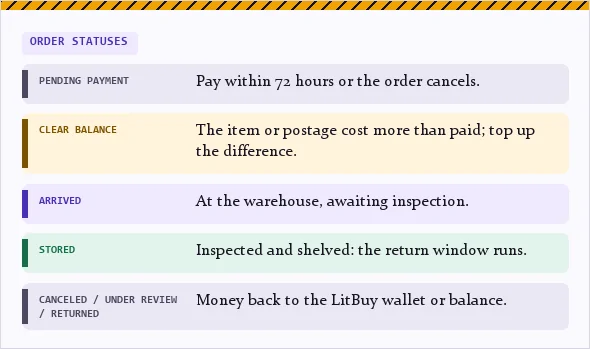
LitBuy's help article 40 lists the statuses an order passes through. Pending Payment gives you 72 hours to pay. Clear Balance means the item or its postage cost more than you paid and you must top up before the purchase continues. Ordered and Shipped (Local) cover the trip to the warehouse.
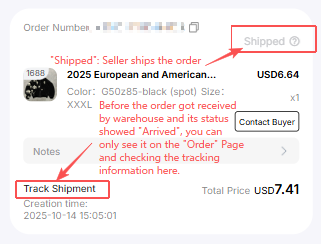
Arrived means the item is at the warehouse “awaiting inspection”; Stored means it has been inspected and shelved, and this is where the return window runs. Canceled, Under Review and Returned are the exits, each ending with money in your LitBuy wallet or balance.
Why LitBuy suits a cautious buyer, and when to use a different agent
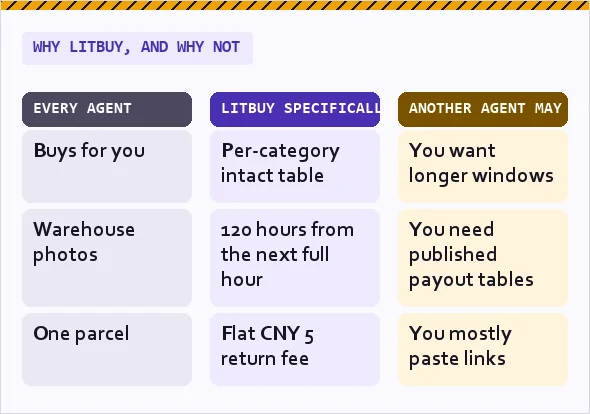
Begin with the things every agent does: it buys for you, photographs what arrives and ships it in one parcel. None of that is a reason to pick one over another.
Why LitBuy, then? For the returns question this site is about, LitBuy publishes its intact standards category by category, counts its window in hours from a defined stamp, and charges a flat CNY 5 fee on top of the two postage legs. These written conditions help identify what to confirm before ordering.
When to use another agent: if you need a window longer than five days in the warehouse, if you want a published compensation table for lost or damaged parcels (LitBuy's is not public), or if most of your orders are pasted links, where LitBuy’s Fill&Buy terms exclude returns without quality or merchant-related problems. Ordinary supported seller links are a different order path.
When other shopping agents come up
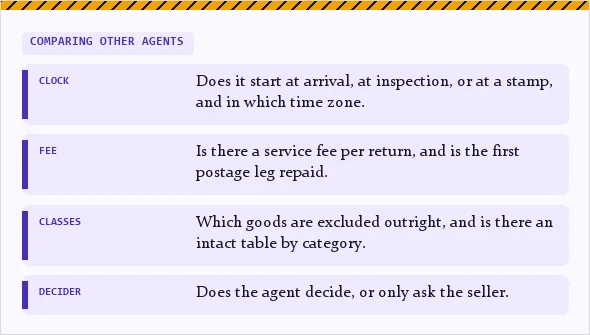
Other shopping agents will come up in any conversation about buying from China, and many of them publish return windows that look like LitBuy's. They are often built on the same marketplace rule, so the useful differences are in the details: where the clock starts, whether the first postage leg is repaid, which classes are excluded, and whether the agent can decide anything or only ask the seller.
We do not list or rank agents here. A list would be out of date before it was useful, and this site only reads LitBuy's pages closely enough to stand behind what it says.
How to judge whether an agent deserves your order
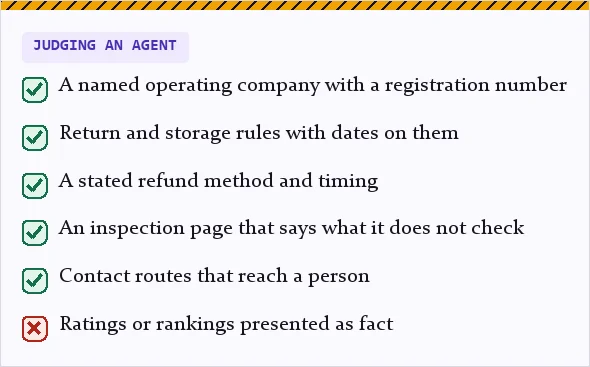
A few checks tell you more than any review. Is there a named company with a registration number behind the site terms? Do the return and storage rules carry dates? Is the refund method stated, with timing? Does the inspection page say what it does not check, as LitBuy's does?
LitBuy passes most of these: LITBUY LIMITED and its company number are on the contact page, the help articles carry update times, the refund timing is stated in business days, and the inspection notes spell out their limits. What it does not publish is a support-hours schedule or its insurance payout table, and its pages disagree with each other in places, which the about page lists.
Shipping in brief: lines, weight and customs
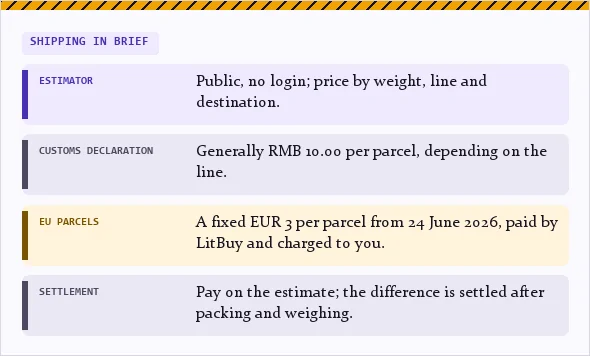
International shipping is priced by weight, shipping line and destination, and LitBuy's freight estimator works without logging in. Most lines charge on the greater of actual weight and volumetric weight. A customs declaration fee of generally RMB 10.00 per parcel applies depending on the line, LitBuy’s 24 June notice described its own EUR 3 per EU parcel arrangement. That dated operator notice does not establish all current destination charges; confirm the route and recipient-country requirements.
You pay on an estimate when you submit the parcel; after packing and weighing the difference is settled. This is also why returns should come first: once a parcel is packed and paid, the items in it are on their way out.
- Help 43 Service & Fees
- Board EU tariff notice, 24 June 2026
Banned goods and what LitBuy says about genuineness
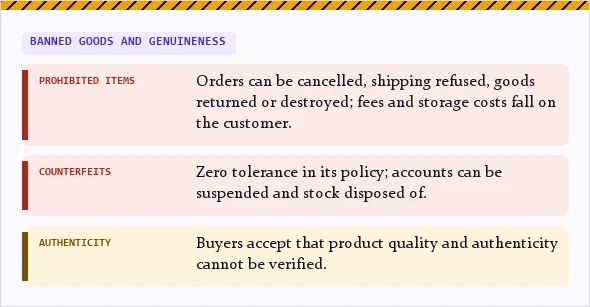
LitBuy's prohibited-items policy says it may cancel orders, refuse shipping, or return or destroy prohibited goods, with fees, storage and disposal costs falling on the customer. Its anti-counterfeit policy goes further for fakes and IP infringement, with account suspension and disposal of stock among the listed responses.
At the same time, LitBuy tells buyers they accept that product quality and authenticity cannot be verified. Neither the warehouse check nor a return request answers that question, and nothing on this site suggests otherwise.
The order budget and warehouse clock
At purchase, allow for the goods and seller-to-warehouse postage. At parcel submission, check international shipping, route handling/declaration charges and any selected packing, rehearsal or insurance service. A foreign-currency display rate and payment-channel fee are separate checks; compare the amount actually debited.
Ordinary goods have a dated 90-day free storage policy, with fees from day 91 and a 120-day maximum. Unmatched incoming goods have a separate 30-day clock. The disposal clauses contain different conditions; confirm the stocked date and required action with support instead of assuming paid storage extends indefinitely. The seller-return window is much shorter.
Before paying for shipping, check restrictions for every item, the packed dimensions, billing-weight rule and claim terms of the selected route. If no suitable route appears, contact support before combining or altering the goods.
One basket can contain several different deadlines
Suppose two shirts arrive on different days and a third purchase is still awaiting dispatch. Check each arrival’s photos promptly and keep its own stored time. The first payment bought the goods and covered relevant local charges; the international parcel has not yet been chosen. Waiting to combine everything is a separate decision from whether each item should be kept.
Before the second payment, compare the proposed packing, route restrictions and billable weight. Allow for payment or conversion charges, requested services and applicable destination costs. Combining purchases can reduce repeated parcel charges, but a bulky package can change the calculation. Resolve return questions before changing packaging, then keep the invoice and item references together so the delivered parcel can be checked against the intended contents.
The official buying screens, in order
LitBuy’s tutorial retained on 16 October 2026. These are older interface examples, not current price or availability quotes. Expand the stage you need; every image links to its original size.
1. Find an item
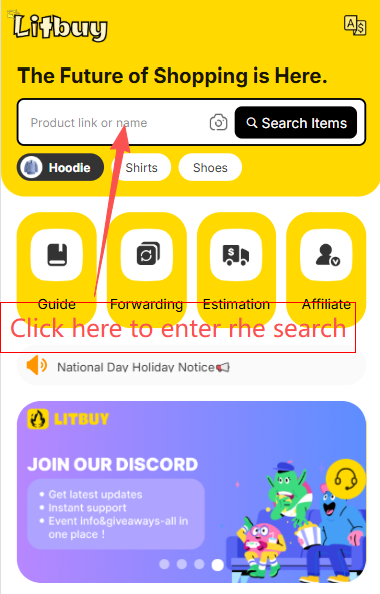
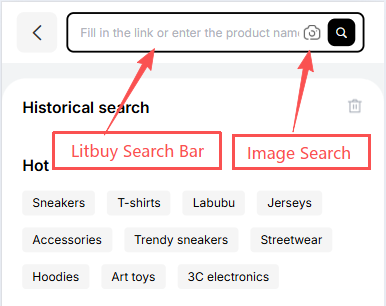
Search by product name, seller link or image. The catalogue helps you discover a listing; check the original seller page before ordering.
2. Create the order
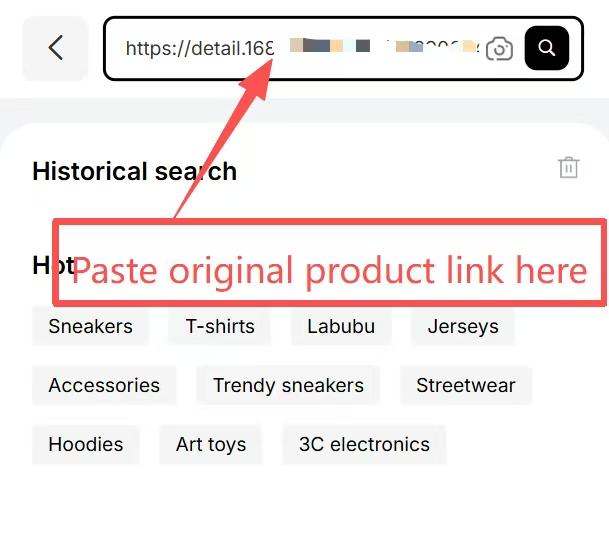
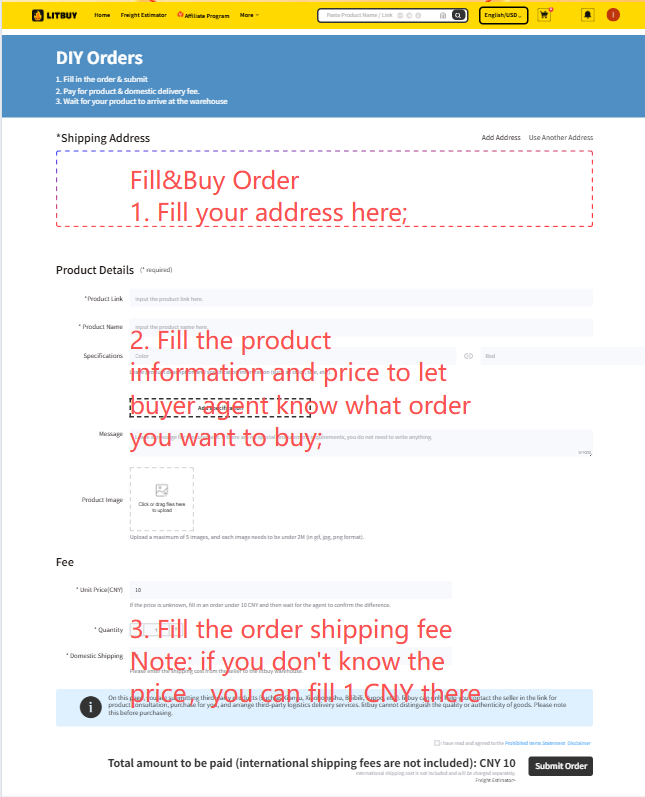
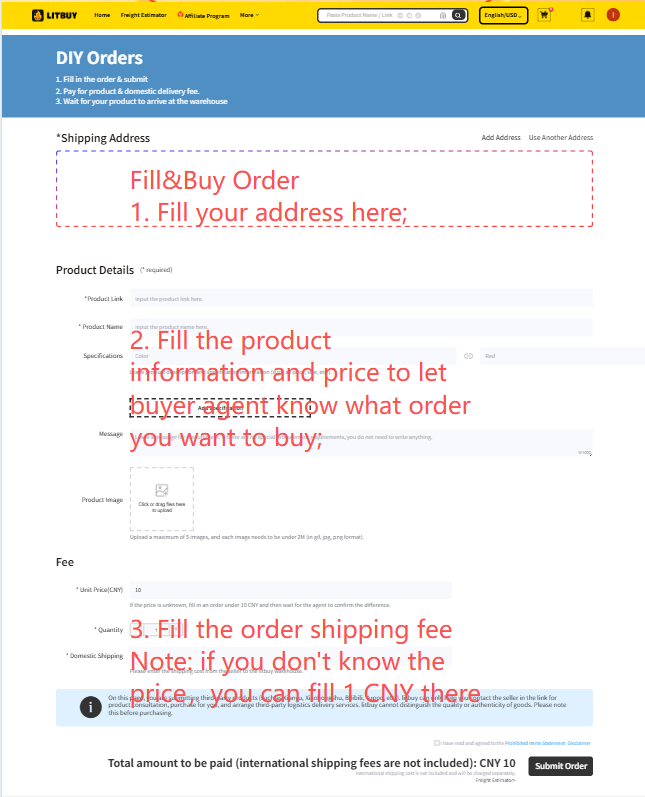
Paste a supported seller link. Use Fill&Buy for a supported listing that cannot be read directly, and confirm the final price. The official article repeats the Fill&Buy screen in images 4 and 5; it is not an extra order step.
3. Choose, confirm and pay
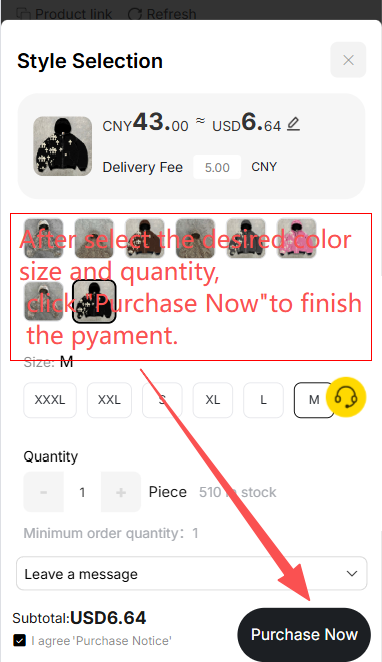
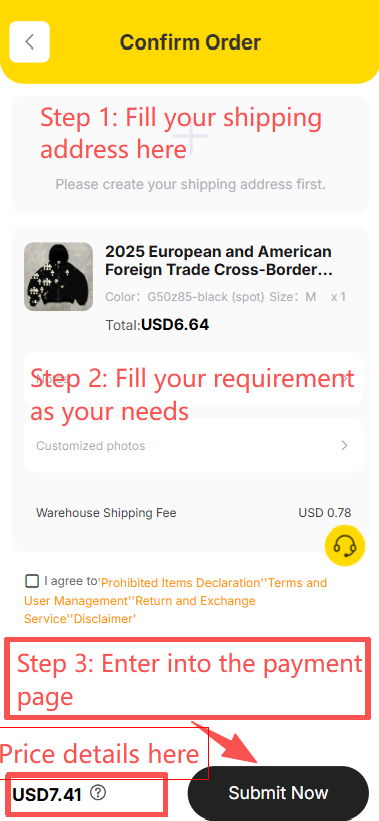
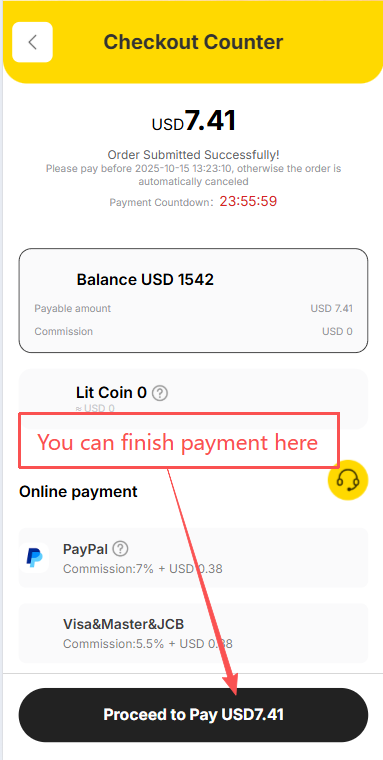
Select the correct variant and quantity, enter instructions, review the destination and pay for the goods and domestic shipping. The screenshot sequence shows variant selection, confirmation and checkout; these screens are offset from some headings in the official article.
4. Follow the seller order
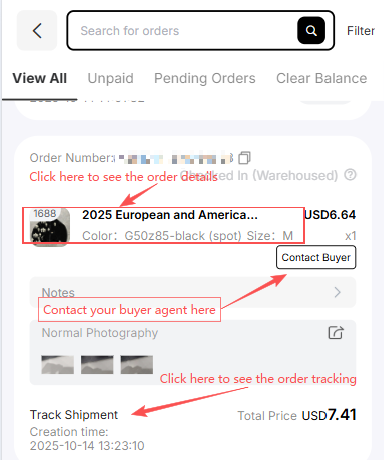
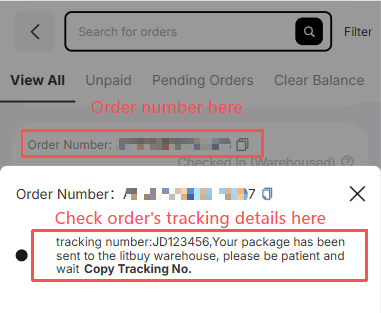
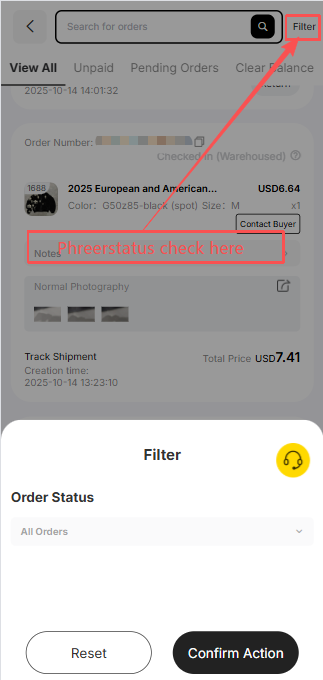
Use Orders to contact the buyer, inspect tracking and filter status. Seller shipment goes to the Chinese warehouse first. Arrival at the delivery point is not yet completed inspection or storage.
5. Inspect stored goods
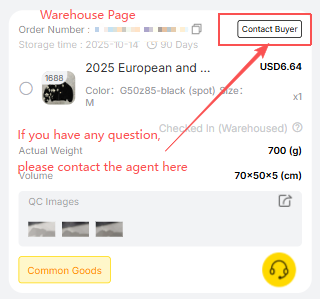
The Warehouse screen shows measurements, QC photos and the buyer contact. Check the actual variant and visible condition promptly, while a seller-agreed return may still be possible.
6. Create and pay for a parcel
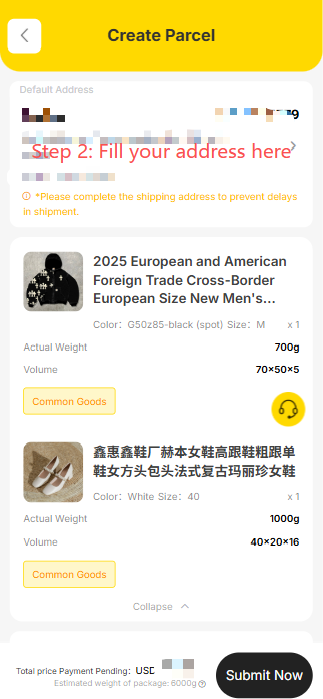
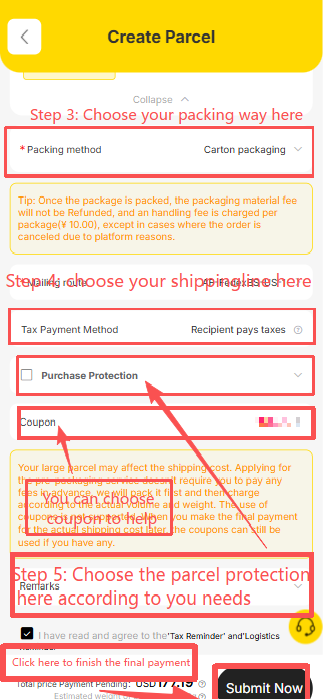
Select stored goods, enter the recipient, choose packing and an eligible route, then check any coupon conditions and pay the shipping estimate. Confirm restrictions for the complete parcel.
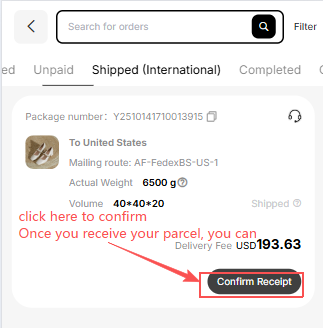
7. Follow international shipping
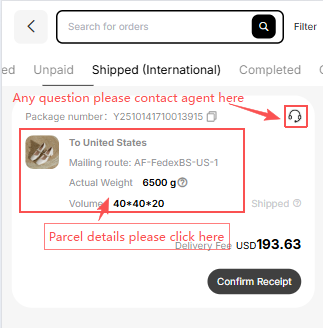
The Parcel page records the dispatched parcel and support contact. Final packed weight and dimensions may change the shipping settlement; pictured prices and routes are examples.
8. Confirm actual receipt
Inspect the parcel and keep evidence before confirming actual delivery. Report a problem through the relevant carrier and LitBuy procedure promptly.
Official How to Use LitBuy article. Its nine status milestones are Order Submitted → Order Placed → Seller Shipped → Arrived at Warehouse → Inspection & Storage → Shipping Requested → Parcel Packed → Shipped → Delivered & Confirmed. Processing times in its summary and detailed text differ; follow the status of your own order.