Five days, counted in hours from the Warehoused stamp
The seller-side return window at LitBuy, read from its own pages: when it starts, how the next-full-hour rule works, what else has to be true, and what happens once the 120 hours are gone.
The seller grants the five days; LitBuy only asks
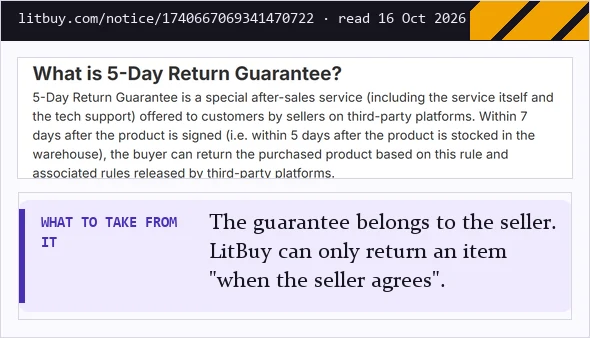
The name suggests a LitBuy promise. The definition says otherwise: the 5-Day Return Guarantee is “a special after-sales service … offered to customers by sellers on third-party platforms”. LitBuy's part is to pass your request on and negotiate, and its notes say plainly that “we can only return the product for you when the seller agrees”.
That has a practical consequence. A seller who does not offer the guarantee, or who has written its own exclusions, can refuse inside the 120 hours and LitBuy has no lever. The eligibility table even keeps an entry for it: “Others stipulated by the seller”, example “Subject to seller rules”.
- Notice Returns & Exchanges
- Help 02 Returns and Refunds, updated 3 July 2026
The next-full-hour rule, worked through
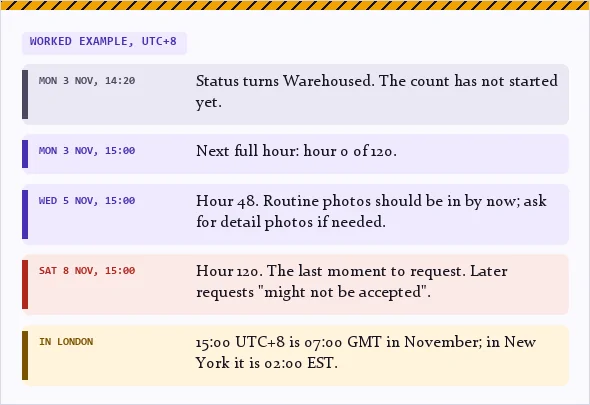
LitBuy's wording is precise: the window opens “beginning from the next hour after the status turns to Warehoused, with five days equivalent to 120 hours”. A stamp at 14:20 therefore starts the count at 15:00, and the last moment to ask is 15:00 on the fifth day after.
Two things the text does not settle. It does not say what happens to a stamp landing exactly on the hour, so treat 09:00 as starting at 09:00 and you will not be late. And it does not name a time zone; LitBuy's footer clock runs on UTC+8, so do the arithmetic in that zone and convert the deadline to your own once, at the start.
Weekends do not pause the count. A Friday-evening stamp gives you the whole weekend, but it also means the seller's working days inside your window are fewer than five.
Seven days after signing, five after stock-in
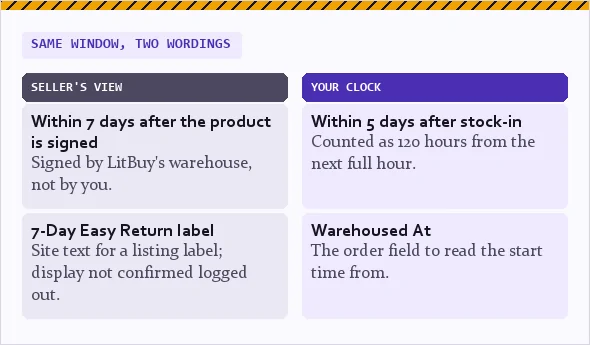
The opening paragraph of the guarantee says a buyer can return within “7 days after the product is signed (i.e. within 5 days after the product is stocked in the warehouse)”. Both numbers describe one window. The seven days are the seller's view, counted from the moment LitBuy's warehouse signs for the seller's parcel; inspection and shelving take part of that, which leaves you five.
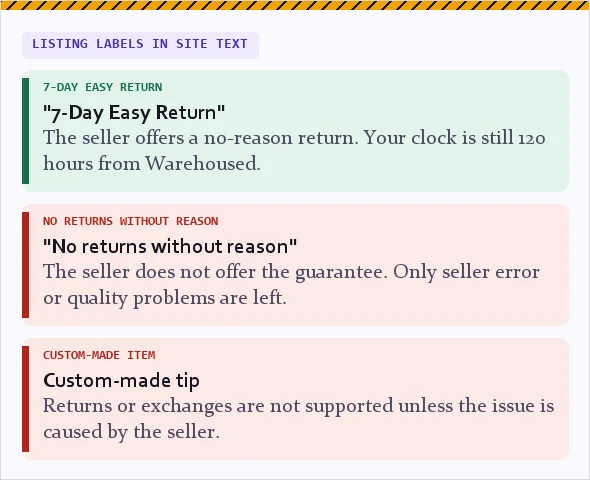
LitBuy's site code also carries a listing label reading “7-Day Easy Return”, next to another that reads “No returns without reason”. We could not open a logged-out product page to see which listings show which, so read them as the seller's stance. Whatever the label says, your own deadline is the 120 hours after Warehoused.
Three labels for one moment: Warehoused, Warehoused At and Stored
The Returns & Exchanges page says the count starts when the order “becomes Warehoused”. The order details on LitBuy label the same moment “Warehoused At”, and the tracking line reads “Item warehoused and shelved”. Help article 40, which lists every order status, calls it something else again: “Stored”, with the reminder that “you have 90 days of free storage”.
They are one event under three names. The one that is not the start is “Arrived”, which help 40 defines as reached the warehouse “and is awaiting inspection”. If your order shows Arrived, the 120 hours have not begun.
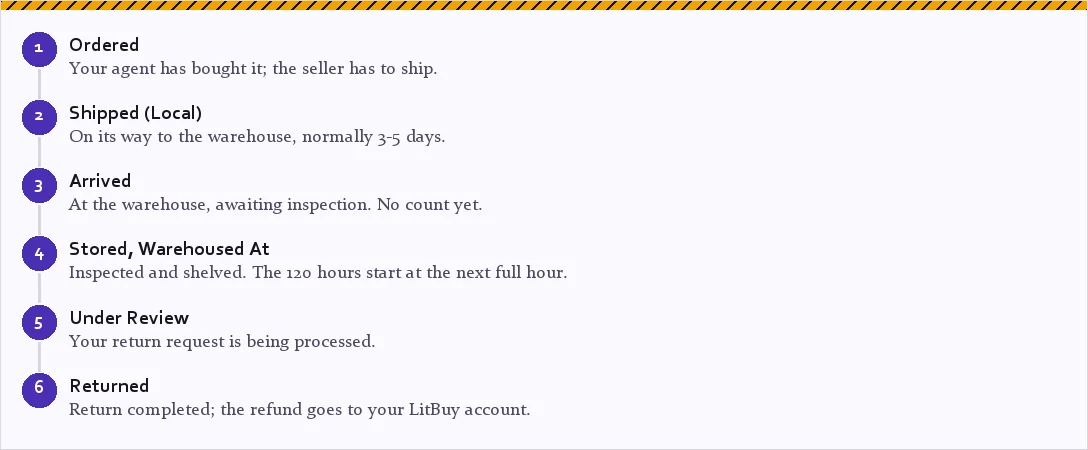
The 90 days of free storage and the five-day return window both start from the same shelving moment, but they are unrelated rules. Keeping an item in storage longer does not extend the right to return it.
Listing labels that promise seven days
Three short strings in LitBuy's site text speak to returns before you buy: “7-Day Easy Return”, “No returns without reason”, and a tip for custom items saying returns or exchanges “are not supported unless the issue is caused by the seller”.
A seven-day label is the seller's promise as written on its home platform. It does not give you seven days at LitBuy; the window you can use is still five days from Warehoused. A no-returns label is the useful one: it tells you before checkout that the change-of-mind route is closed for that listing, whatever its category card says.
Labels and cards can disagree, and the label wins in one direction only. A Level D card such as bags or tees describes the plainest LitBuy rule, but a no-returns label on that listing closes the route, because the guarantee is the seller's to give. A seven-day label on a sealed perfume, on the other hand, does not lift the seal rule: the Special Standards still apply.
What has to be true besides the clock
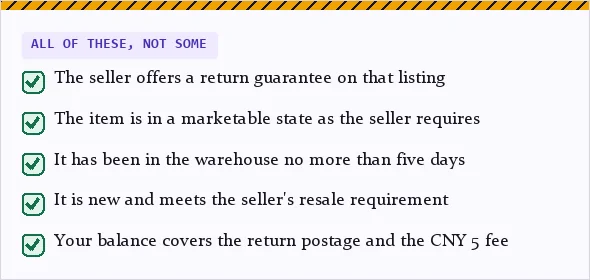
The “Available” row of the eligibility table lists three requirements that all have to hold: a guarantee on offer from the seller, an item is “in a marketable state as required by the seller”, and its time in the warehouse “does not exceed 5 days”. The FAQ adds that the product “must be new and meet the resell requirement”.
The notes add a practical one: keep enough balance in your account to cover the return postage and the service fee, because they are charged when you request. A request that cannot be paid for stalls while the hours run on.
Before the seller ships, a change of mind is free
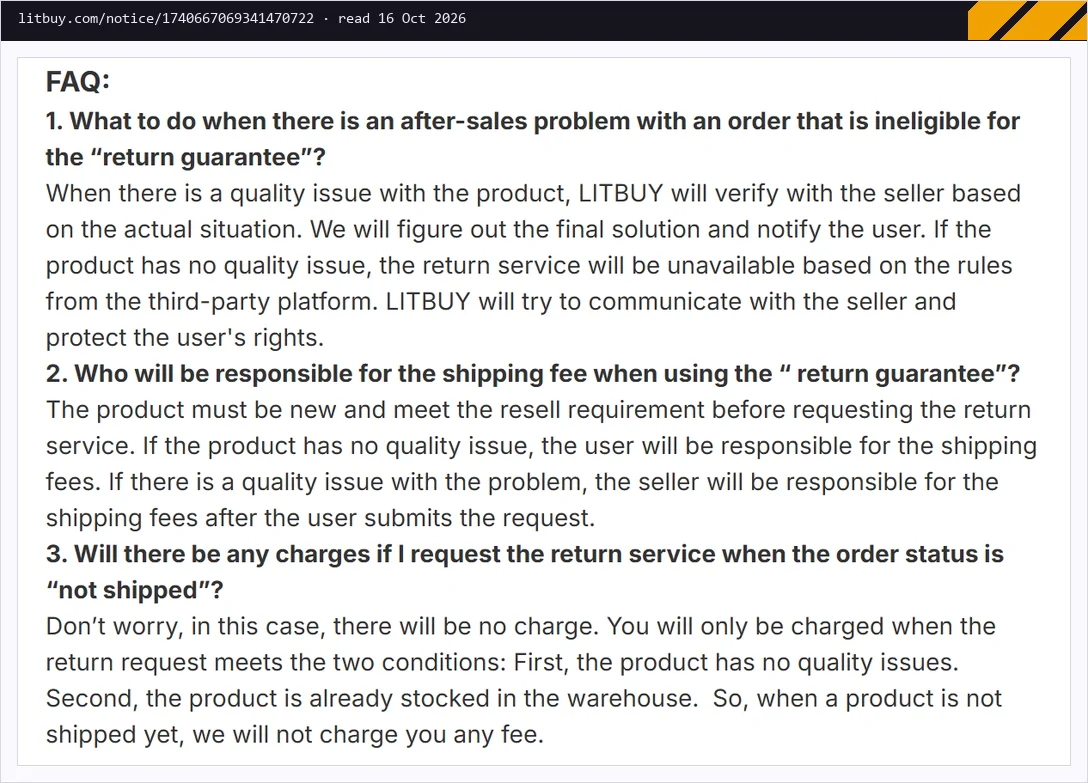
The third FAQ answer is the least costly exit in LitBuy's rules. A return request on an order that is still “not shipped” costs nothing: you are charged only when two conditions meet, the product has no quality issue and “the product is already stocked in the warehouse”.
So the best time to have second thoughts is before the seller dispatches, which is usually within a day or two of purchase. Cancelled orders go back to your LitBuy balance; LitBuy's site text says “the refunded order amount and domestic logistics fees will be returned to your balance”.
When the 120 hours have passed
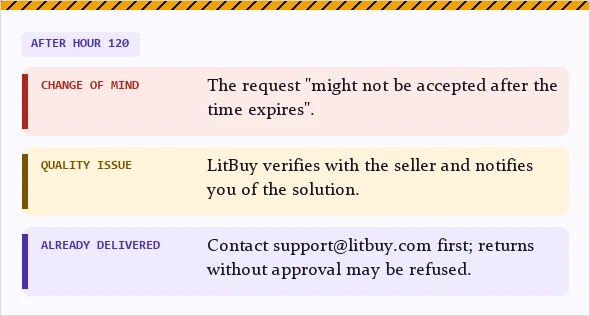
After the window, LitBuy says a request “might not be accepted”. It does not say never, but nothing obliges a seller to agree.
A quality problem is a different matter. The first FAQ answer says that when there is a quality issue LitBuy “will verify with the seller based on the actual situation” and notify you of the outcome, even for items that were never eligible for the guarantee. Once the parcel has reached you, returns move to the upper half of the Returns & Exchanges page: ask support first, wait for a return address, and expect to pay the postage unless LitBuy or the product was at fault. Return costs sets that route out.