Special Standards: the per-category meaning of unused
LitBuy defines intact separately for each kind of product. Here is every entry of its table, the twin copy with different wording, and what the rules mean when your item sits in a warehouse in Xiamen.
One table, published twice with different wording
LitBuy publishes its Special Standards in two places. The Returns & Exchanges page links “the attached table” to notice 1904784303003881473, titled Reference Standards for Intact Product Packaging; the same text is help article 15, last updated 30 June 2026. Help article 02, Returns and Refunds, updated three days later, carries its own copy under the heading Special Standards.
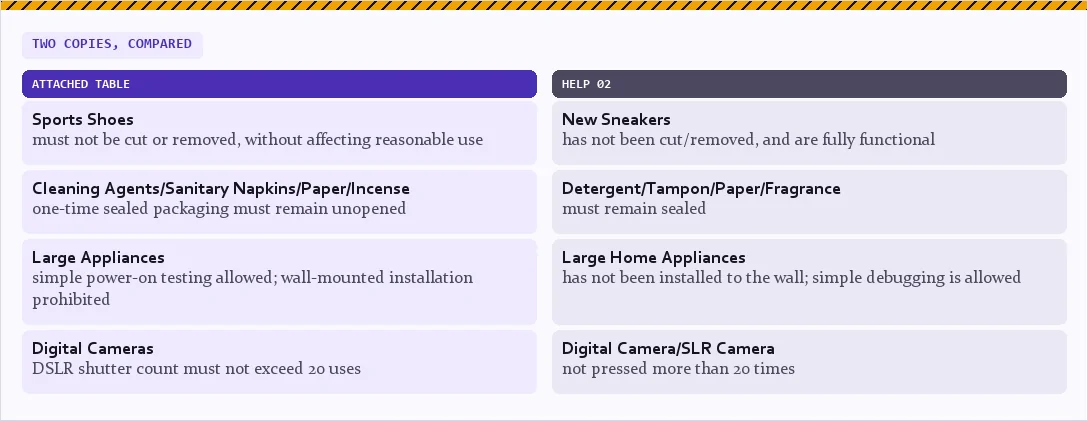
The rules agree; the words do not. Category names differ, some conditions are phrased as prohibitions in one and as states in the other, and help 02 spells out the electronic consumables in more detail. Where a difference could change an outcome, this page shows both and leans on the stricter reading.
- Notice attached table
- Help 15 updated 30 June 2026
- Help 02 updated 3 July 2026
Sports shoes: the tag that must not be cut
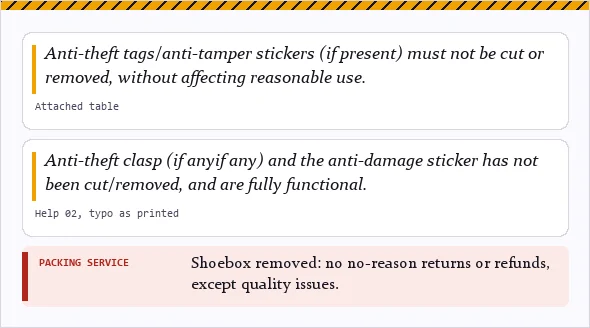
The attached table calls the category Sports Shoes; help 02 calls it New Sneakers. Both protect the same two things: an anti-theft tag or clasp, and an anti-tamper sticker, each only “if present”. Help 02 adds “and are fully functional”, which reads as the tag still working, not just still attached.
At LitBuy the tag is rarely the problem, because nobody tries the pair on inside the warehouse. The box is. The remove-shoebox packing service carries its own notice: the shoebox “is part of the product packaging”, and pairs without it lose no-reason returns.
Personal care families and the one-time seal
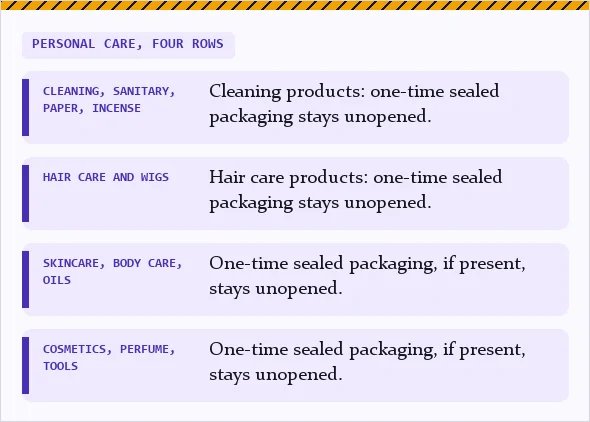
Four rows of the table cover personal care, and they all say the same thing with small variations: the one-time sealed packaging stays unopened. The cleaning and hair-care rows narrow it with “if applicable” to the products themselves; the skincare and cosmetics rows say “if present”.
Wigs and beauty tools are the interesting cases. A wig in a sealed bag is held to the seal; a brush set without a seal is judged on the general test of unused and complete. The listing photos usually show which it is.
Perfume is the common case in a finds catalogue. A boxed bottle in an outer cellophane wrap has a seal in LitBuy's sense, so the wrap is the return right; a tester bottle or an unboxed decant has no seal at all and is judged on the general test, which in practice means unused and nothing more.
Digital goods, cameras and big appliances
Digital products and home appliances (cameras and large appliances excepted) have two conditions: the network access licence sticker, where the product has one, is undamaged, and there has been no liquid immersion. Cameras have one condition, a DSLR shutter count of twenty or fewer, which is checkable from the camera itself and is the only number in the whole table.
Large appliances read like a domestic-delivery rule: an LCD television or air conditioner may be powered on briefly but not wall-mounted, and a washing machine may not have had water through it. Very few LitBuy parcels contain a washing machine; the entry is there because the table was written for shoppers who receive goods at home.
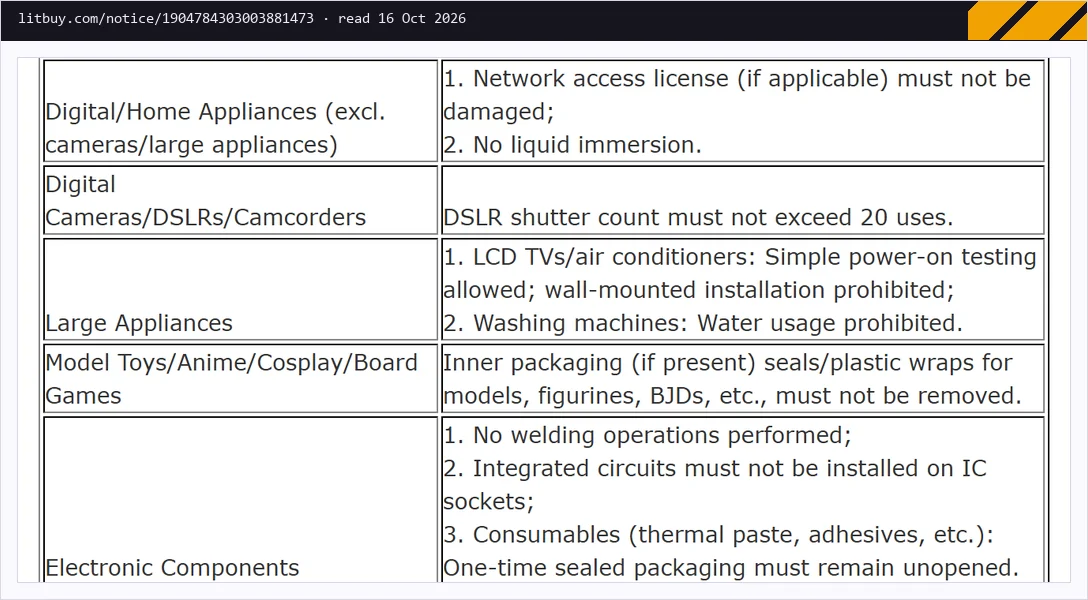
- Notice attached table, rows 6 to 10
Electronic components: solder, sockets and sealed glue
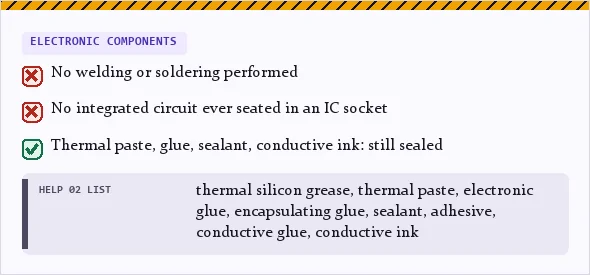
The components row has three parts. No soldering, no integrated circuit ever installed on an IC socket, and consumables such as thermal paste and adhesives left in their one-time sealed packaging.
Help 02 lists the consumables by name: thermal silicone grease, thermal paste, electronic glue, encapsulating glue, sealant, adhesive, conductive glue and conductive ink. If you build kits, the rule is simple: test-fit nothing until you are past the 120 hours or sure you are keeping it.
Figures, anime goods, cosplay and board games
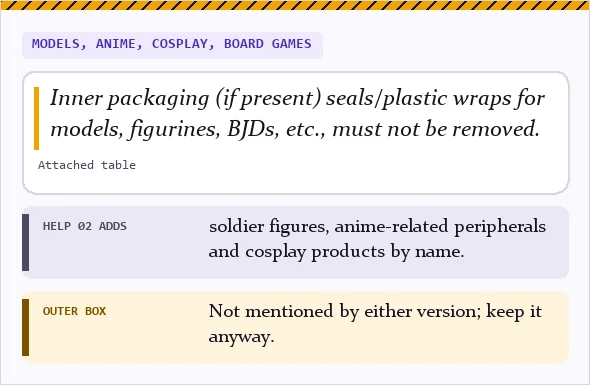
This row protects the inner packaging: seals and plastic wraps on models, figurines and ball-jointed dolls must not be removed. Help 02 lists the same goods more widely, including soldier figures, anime-related peripherals and cosplay products.
Neither version mentions the outer box, which is what collectors care about most. Treat it as packaging under the general rule and keep it.
Blind boxes are the edge case. Their whole point is the sealed inner bag, so we read that bag as the inner packaging this row protects: open it and the change-of-mind route is gone. The entry itself names models, figurines and BJDs, so this is our reading rather than LitBuy's wording.
Game software, pet care and farm supplies
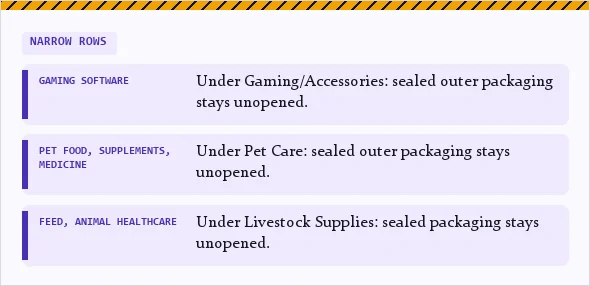
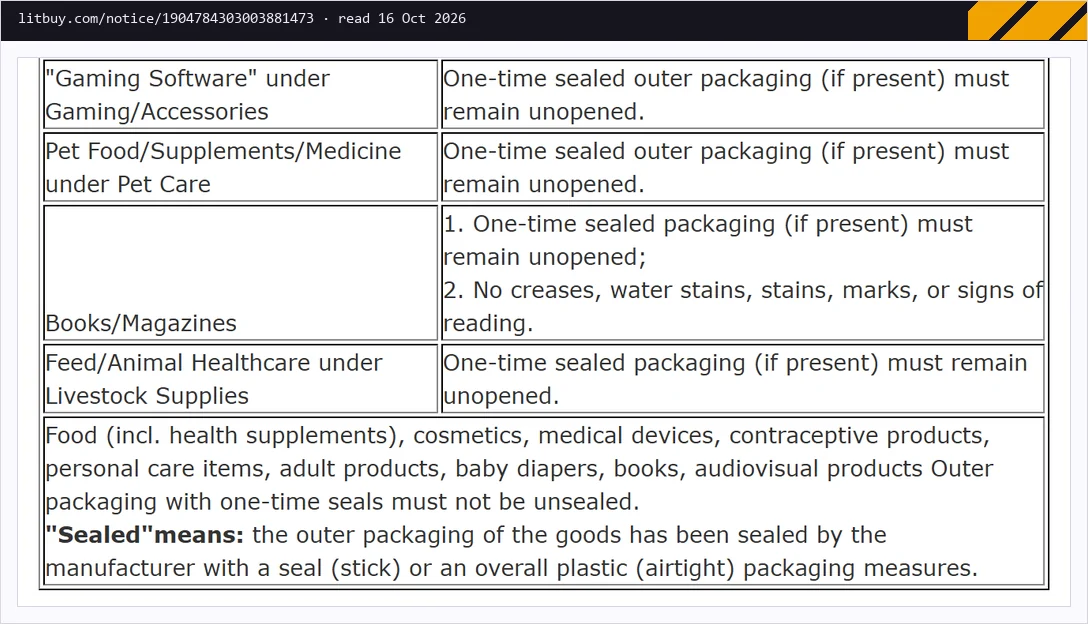
Three rows reach into LitBuy's product tree by name. “Gaming Software” under Gaming/Accessories, pet food, supplements and medicine under Pet Care, and feed and animal healthcare under Livestock Supplies. Each keeps the one-time sealed outer packaging closed.
The level names (help 02 calls them Level I and Level II categories) show that the table follows a marketplace's category tree. A controller sold under accessories is not game software, so the sealed-software rule would not apply to it.
Books and magazines: no creases, no reading marks
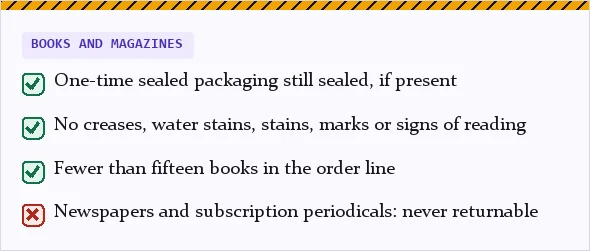
Books get the most detailed condition test in the table: sealed packaging still sealed if there is one, and “no creases, water stains, stains, marks, or signs of reading”. Help 02 phrases the second part as no traces of folding, ink or reading.
Two rows of the ineligible column also reach books. Newspapers and periodicals, with the example “Subscripted books and periodicals”, are never a no-reason return; nor is an order of fifteen or more books, printed in LitBuy's table as “Books (≥15)”.
What LitBuy means by sealed
The last cell of the table defines the word the rest depends on. In LitBuy's definition a product counts as sealed when its maker closed the outer pack itself, either with a seal sticker or with an all-over airtight plastic wrap. A seller's own tape around a box does not count; a maker's sticker or shrink-wrap does.
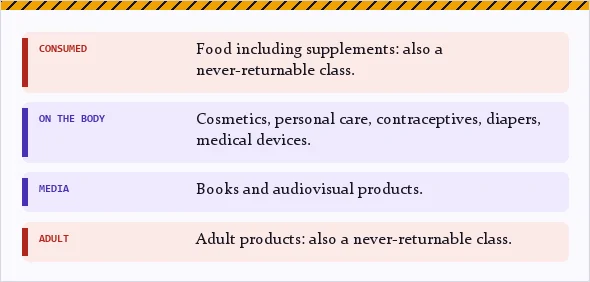
Above it sits a catch-all line naming food (health supplements included), cosmetics, medical devices and contraceptives, then personal care, nappies, books, audiovisual goods and adult goods: none of them may have a one-time-sealed outer pack opened. If a product is in that list and arrives in shrink-wrap, the shrink-wrap is the return right.
- Notice attached table, last rows
The catch-all sentence at the foot of the table
The closing line widens the seal rule beyond the named rows. Read it against the ineligible column and two of its entries, food and adult products, turn out to be never returnable for a change of mind anyway, sealed or not.
The rest of the list (cosmetics, personal care, contraceptives, baby diapers, medical devices, books, audiovisual products) is returnable only with the seal intact. Audiovisual products also meet a warehouse rule: sealed CDs are not opened for inspection, so their condition is judged from the outside.
Where the two versions part ways
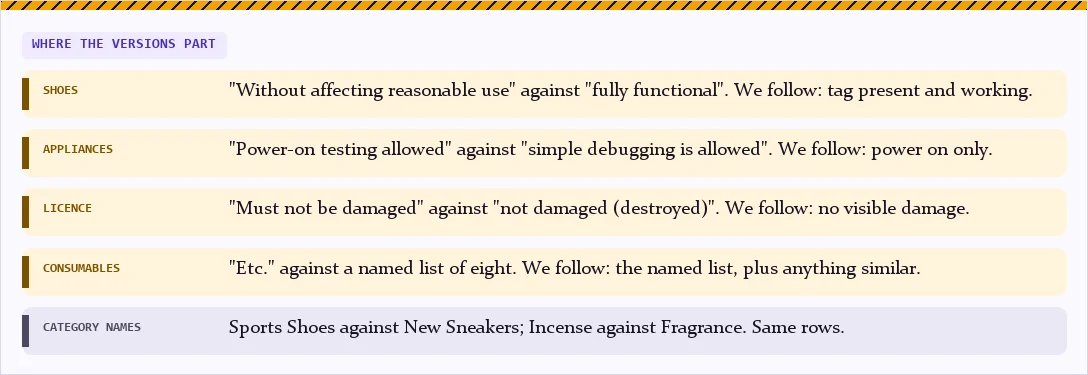
Five differences are worth knowing. The shoe row says “without affecting reasonable use” in one copy and “fully functional” in the other. The appliance row allows “simple power-on testing” in one and “simple debugging” in the other. The licence condition is “must not be damaged” against “not damaged (destroyed)”. The consumables list is an “etc.” against eight named products. And the category names drift: Incense in one, Fragrance in the other.
Our rule of thumb: follow whichever copy asks more of you. The attached table is the one LitBuy's Returns & Exchanges page links to; help 02 is the newer by three days. Neither says it replaces the other.
Reading the table for a LitBuy order
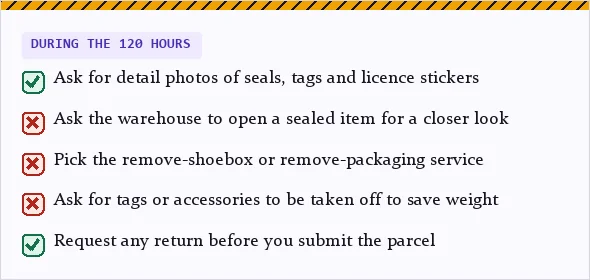
The table was written for shoppers who receive goods at home and might open them. At LitBuy the goods sit in the warehouse during the 120 hours and you never touch them, so the risk comes from what you ask for: a closer look that needs a seal opened, a packing service that throws away a box, tags taken off to cut weight.
Detail photos are the safe way to look. They cost 1 yuan each per LitBuy's help page and need nothing opened if you ask for the outside of a seal or the face of a tag. Reading warehouse photos lists what to ask for, family by family.