Before checkout: picking items and sellers you could still send back
The return rules work best before you pay. Here is what to check about the seller, the listing and your own plans while the item is still only a link.
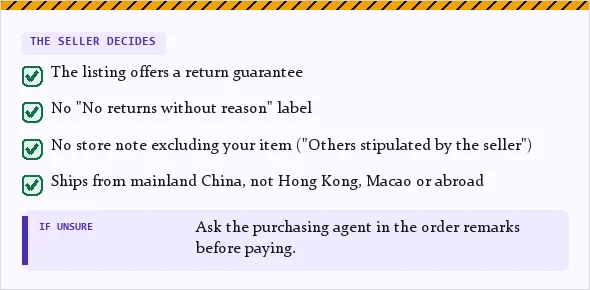
Check that the seller offers the guarantee at all
How to choose a seller when returns matter comes down to one question: does this seller offer the guarantee, and on what terms. LitBuy can only return an item “when the seller agrees”, and its table leaves room for each seller's own list (“Others stipulated by the seller”).
Good sellers for a cautious order state their return terms on the listing, ship from the mainland, and do not carry a no-returns label. A store with clear size charts and photos of the actual packaging also makes the warehouse photos easier to check against.
Reading a listing for its return clues
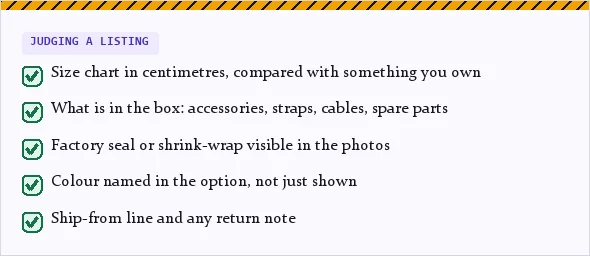
Judging a listing before you order is mostly about the things the warehouse will not judge for you. Size error and colour difference are outside inspection, so the size chart in centimetres and the named colour option are your protection.
List what the box should contain. The accessories clause in LitBuy's table means a return needs every strap, cable and spare part, and the warehouse photos can only be checked against a list you made. If the listing photos show a factory seal, expect the seal rule to apply.
Personalisation, made-to-measure and prescription orders
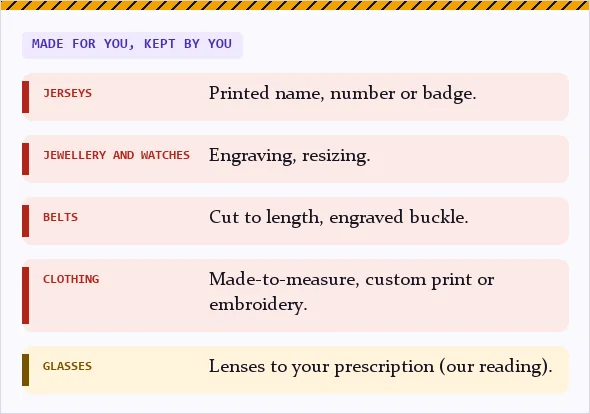
Anything made for you is custom-made in LitBuy's table, and custom-made is the first row of the ineligible column. LitBuy's own tip for custom items says returns or exchanges are not supported unless the seller caused the problem.
That is not a reason to avoid personalisation, only a reason to order it last. Buy the plain version first if you are unsure of the size, and add printing or engraving once you know the fit.
A seller mistake on a personalised piece is still a seller mistake. A misspelt name or the wrong number on a jersey falls under the seller-error entry of the responsibility table, not under custom-made, so keep the exact wording you asked for in the order remarks as your record.
Sets, bundles and multi-packs go back whole
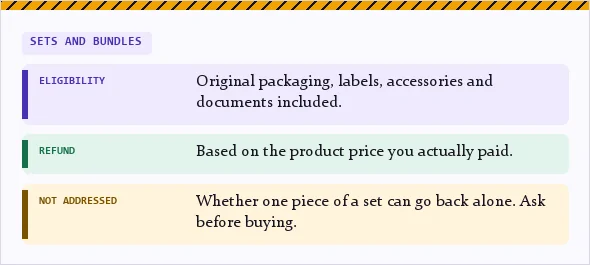
LitBuy's eligibility rules ask for “the original packaging, labels, accessories, and documents”. A three-pack of tees or a gift set is one product in that sense, so the expectation is that it goes back complete.
Whether one piece of a set can be returned alone is not addressed anywhere in LitBuy's pages. If you might want that, ask the purchasing agent to check with the seller before you pay. The answer, whichever way it goes, is worth having in writing before the 120 hours start.
Questions to put in the order remarks
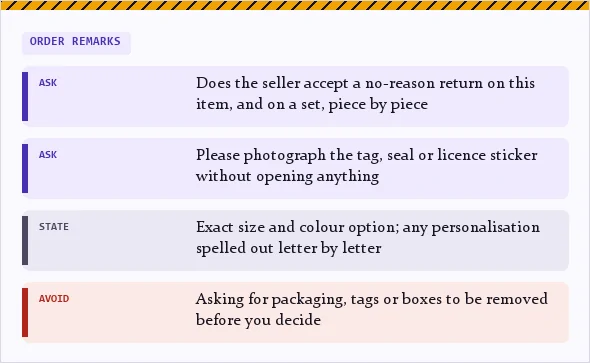
LitBuy's order forms have a free-text remarks box (on the Fill&buy form it allows up to 1,000 characters). It reaches the purchasing agent who deals with the seller, so it is the right place for return questions.
Ask whether the seller accepts a no-reason return for that item. Ask for a photo of the tag, seal or licence sticker without opening anything. Spell out size, colour and any personalisation. Do not ask for packaging to be removed until you know you are keeping the item.
Write one question per line and keep a copy of what you sent. If a seller later says it never offered a return, or the warehouse photos show something other than what you asked for, the remark is the record that you raised it before paying.
One cart, four return answers
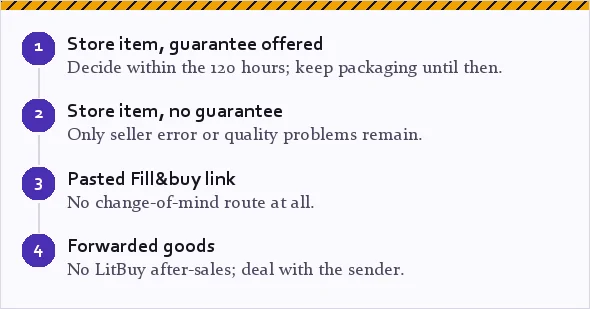
A single LitBuy cart can hold items with four different return answers: store items whose seller offers the guarantee, store items whose seller does not, links pasted into Fill&buy, and goods forwarded from elsewhere. Only the first group has a change-of-mind window.
Plan the parcel around that group. Items arrive at different times, each with its own Warehoused stamp, so each has its own 120 hours. Submit the parcel, and choose any space-saving packing, once the last of those windows has closed or you have decided to keep everything in it.
A pre-cart checklist for each level
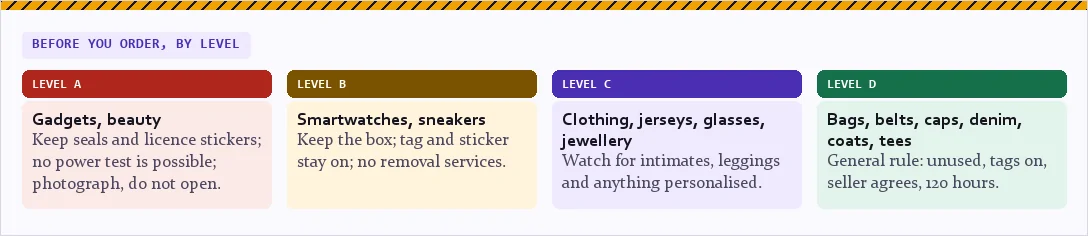
Before you order anything with a return in mind, find its card and work through the line for its level. The checks get shorter as the levels go down, but the general rule at the bottom still applies to everything above it.
One last thing to watch for at every level: the 120 hours run in UTC+8 and do not stop at weekends, so a Friday-night shelving leaves fewer seller working days than it seems.